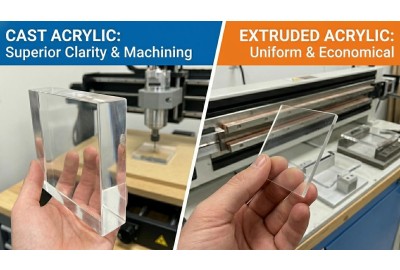
Acrylic sheets are a versatile and strong alternative to glass, but the two main types - Cast and Extruded (XT) - have key differences that affect performance, fabrication, and cost. Use this guide to determine which one is the right fit for your project.
1. Understanding the Manufacturing Difference
Material
Cast Acrylic
Extruded (XT) Acrylic
Process
Poured and cured in a mold (like baking a cake).
Melted pellets pushed through a die (like toothpaste from a tube).
Thickness Tolerance
Less consistent (up to +/-10% +0.4mm variation).
Highly consistent (typically +/- 3% variation).
Colour Availability
Wide range of colours and finishes.
Limited colour range and finishes.
Cost
More expensive.
Less expensive.
2. Best Applications: Which Type Is Right For Your Project?
Project
Recommendation
Reason
Basic Framing or Windows (Shed, Garage)
Extruded
Consistent thickness and good clarity are sufficient for general purpose use.
Projects Requiring Bending/Forming
Extruded
Easier and faster to heat and shape due to its lower melting temperature.
Projects Involving Laser Cutting or Engraving
Cast
Excellent etching/engraving quality and better for laser cutting.
Projects Involving CNC Machining
Cast
Less likely to chip, melt, or become pliable during the machining process.
Budget-Sensitive Projects
Extruded
Significantly lower cost per sheet.
Projects Involving Bonding Panels Together
Extruded
Lower chemical resistance allows for more effective solvent bonding, and better thickness tolerance provides greater accuracy when joining panels.
3. Fabrication & Machining: Which Cuts Better?
The way you plan to cut or shape the acrylic is often the most critical factor in your decision.
Choose CAST Acrylic if you are:
· Laser Cutting: It produces a clean, polished, glass-like edge with very little residue. The material vaporizes cleanly, making it ideal for intricate designs.
· Engraving: Cast acrylic engraves beautifully and offers a frosty white finish, making it the material of choice for laser engraving.
· Routing/CNC Machining: Its hardness makes it less likely to chip or melt during high-speed machining.
· Polishing: It can be polished to a superior, high-gloss edge.
Choose EXTRUDED Acrylic if you are:
· Thermoforming/Bending: It has a lower melting point, making it easier and faster to heat and bend or vacuum form.
· Simple Cutting: For straight cuts using a saw.
· Drilling: While both are drillable, extruded is slightly less prone to cracking if you are careful with the feed rate.
We hope this guide has been helpful however should you still have any questions, feel free to get in touch and our customer service team will be more than happy to help with your enquiry.